
By: Staff Writer
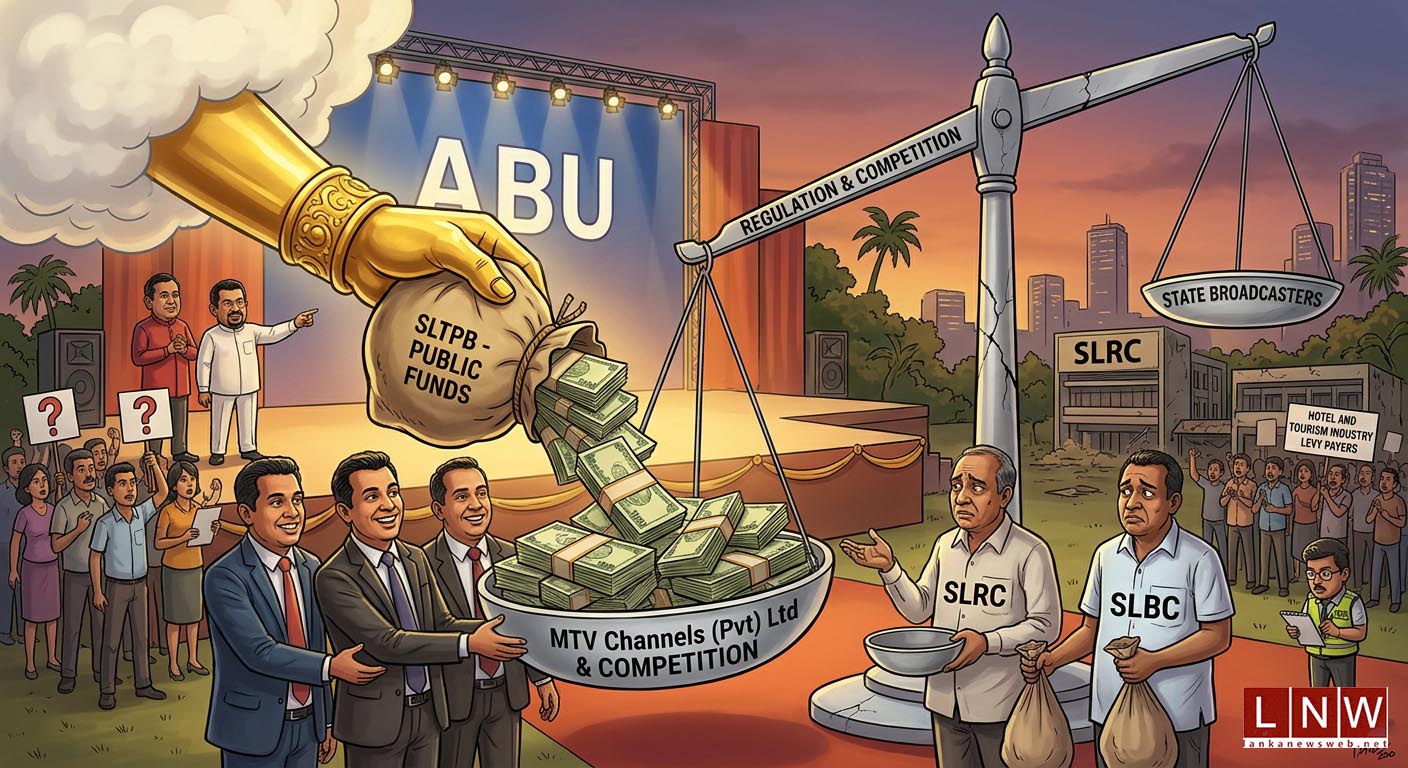
November 08, Colombo (LNWE): The Rs.104.6 million sponsorship provided by the Sri Lanka Tourism Promotion Bureau (SLTPB) to MTV Channels (Pvt) Ltd for hosting the 63rd General Assembly of the Asia-Pacific Broadcasting Union (ABU) has opened a wider debate about the National People’s Power Government’s commitment to institutional independence, public-sector accountability and equal treatment of private and state-owned media organisations.
While the Government describes the arrangement as an innovative investment in international tourism promotion, the decision has exposed a fundamental weakness in the administration’s explanation: the distinction between possessing authority to spend statutory funds and demonstrating that such expenditure was fair, competitive and in the public interest.
The involvement of Tourism Minister Vijitha Herath and Health and Mass Media Minister Dr. Nalinda Jayatissa is particularly significant because the controversy falls across two important areas of ministerial responsibility.
Minister Vijitha Herath must explain why the tourism promotion institution considered a contribution exceeding Rs.104 million necessary, how the expected tourism benefits were calculated and whether alternative promotional arrangements were examined before the Cabinet approved the expenditure.
The fact that the funds originated from the US$5 tourist arrival levy and the one-percent hotel levy does not remove the responsibility to demonstrate value for money. These are statutory resources collected through the tourism industry and must ultimately serve the country’s broader economic interests.
For Dr. Nalinda Jayatissa, the controversy carries a different dimension. As the Minister responsible for mass media, he must address whether the Government’s decision has created an uneven playing field between private broadcasters and publicly funded institutions such as the Sri Lanka Rupavahini Corporation and the Sri Lanka Broadcasting Corporation.
Both state broadcasters possess extensive experience in international broadcasting cooperation and have historically represented Sri Lanka in regional and international media organisations.
Why, therefore, was a private commercial broadcaster entrusted with an assignment involving such a substantial public sponsorship? Was the possibility of involving state broadcasters considered? Could a partnership involving public and private broadcasters have achieved the same international exposure at a lower cost?
These questions deserve answers independent of political affiliations or commercial interests.
The Government’s argument that MTV had already obtained the ABU hosting rights through an international selection process in Türkiye is relevant. However, securing the right to host an international event does not necessarily establish an automatic entitlement to receive public financial assistance.
The Cabinet-approved arrangement reportedly provided for 60 percent payment upfront, leaving 40 percent conditional upon the completion of performance assessments. This makes the final Rs.41.8 million particularly important.
The Government must publish the relevant performance criteria, the memorandum of understanding, the expenditure breakdown and the independent assessment of the promised Rs.250 million in international media exposure.
The controversy also raises concerns about the effectiveness of regulatory safeguards governing state-controlled commercial activities. If procurement procedures are considered unsuitable for creative and promotional services, the Government should establish transparent alternative guidelines rather than rely on case-by-case exemptions.
The complaint submitted to the Commission to Investigate Allegations of Bribery or Corruption (CIABOC) by the Social Media Journalists for Democracy Collective should be examined impartially. Filing a complaint does not establish wrongdoing, but neither should the Government’s political explanation substitute for an independent investigation.
There is also a wider danger in allowing public institutions to become financially dependent on decisions that favour selected commercial organisations without clearly established competitive safeguards.
For an administration that came to power promising transparency, accountability and an end to political patronage, this controversy presents an important test.
The issue is not whether private broadcasters should receive opportunities to promote Sri Lanka internationally. They should. The real question is whether public money is distributed according to transparent rules that protect both taxpayers and fair competition.
Good governance requires more than defending expenditure; it requires proving that every rupee was spent in the public interest.