January 02, World (LNW): In a dramatic incident at Tokyo’s Haneda airport, a Japan Airlines plane caught fire upon landing on Tuesday (02) evening, Japan’s NHK reported.
Shocking footage aired on NHK revealed flames emanating from the windows and beneath the aircraft, with the runway itself also set ablaze.
The aircraft, which originated from Sapporo, reportedly collided with a coast guard plane during the landing. Fortunately, all 379 passengers and crew on board were safely evacuated, as confirmed by the airline, according to NHK.
Japan Airlines is currently evaluating the extent of the damage, and the affected flight, Japan Airlines Flight 516, had departed from New Chitose airport at 16:00 local time and was scheduled to arrive at Haneda at 17:40.
The alarming TV footage captured the presence of multiple fire trucks at the scene, working to control the situation as smoke and flames billowed from the aircraft.
The incident has triggered heightened concerns about aviation safety, prompting authorities to investigate the circumstances surrounding the collision and subsequent fire.
This article is an update of the article series on CB’s monetary policy operations to cover the year 2023. The article
provides highlights on money printing operations and resulting money market outcomes favourable to wholesale money dealers,
covers only domestic monetary operations as CB’s foreign currency operations also are captured in domestic monetary operations which are designed to neutralize the impact of foreign currency operations on the domestic currency liquidity at levels desirable to the CB, and
raises serious concerns over the appropriateness and governance of the present monetary policy model to recover the economy from the bankruptcy caused by the monetary policy itself.
However, the policy story of inflation control by the monetary policy operations was not covered in the article as it is only a fictitious and tribal economic concept not proved by real world data in any country. If central banks were capable of controlling inflation as enumerated, the world should not have been pushed into three-decades high and persistent inflationary pressures since the beginning of 2022.
As monetary operations are responsible for providing a stable and sufficient monetary sector to suit real sector needs of the economy, it is the duty of the general public to question whether such monetary operations have performed their public duty. Therefore, this article also provides a guidance in this regard.
Monetary Operation Instruments – 2023
The main monetary operation instruments used in 2023 are listed below.
Policy interest rates (SDFR and SLFR)
This is the policy rates corridor which is expected to limit the variability of overnight inter-bank interest rates. Therefore, policy rates are the prices charged on printing of money from the air in computers at zero variable cost.
Money printing
Standing facilities, reverse repo lending, intra-day liquidity facility and direct/primary purchase of Treasury bills are the major printing operations. As they change the supply of reserves, the CB can manipulate their prices/interest rates to influence inter-bank interest rates.
Statutory Reserve Ratio (SRR)
This is the regulatory instrument used to affect the flow of usable reserves of banks and thereby inter-bank interest rates.
Monetary Operation Highlights – 2023
Policy interest rates
Policy interest rates were raised by 1% to 15.5%-16.5% in March and then reduced four times in total of 6.5% to 9%-10% from the end of May.
The Monetary Policy Board (MPB) at the last meeting held on 23 November has signaled a pause in the policy rates cut cycle in view of the space available for market interest rates to decline further.
However, policy rates-based monetary policy model has collapsed from 16 January 2023 as the CB has severely restricted financial facilities offered at policy rates.
It is hard to understand why the CB charges such high interest rates on just printing of money from the air without any variable cost. The confusion goes mad as the central bank of Turkey raised its policy rate to 42.5% last month while it is 133% in Argentina.
Standing facilities
These are overnight facilities provided to keep the variability of overnight inter-bank interest rates within the policy rates corridor. However, as the CB has capped these facilities from 16 January, the fixed policy rates corridor-based policy model has been dormant.
Caps are the restrictions on the deposit facility (SDF) to five times/days a month and the lending facility (SLF) to 90% of the SRR for each bank. This is nothing but rationing of the supply at controlled prices. Therefore, standing facilities have failed to serve their job.
As such, the facilities window has been highly irregular and dormant not showing any meaningful monetary policy purpose.
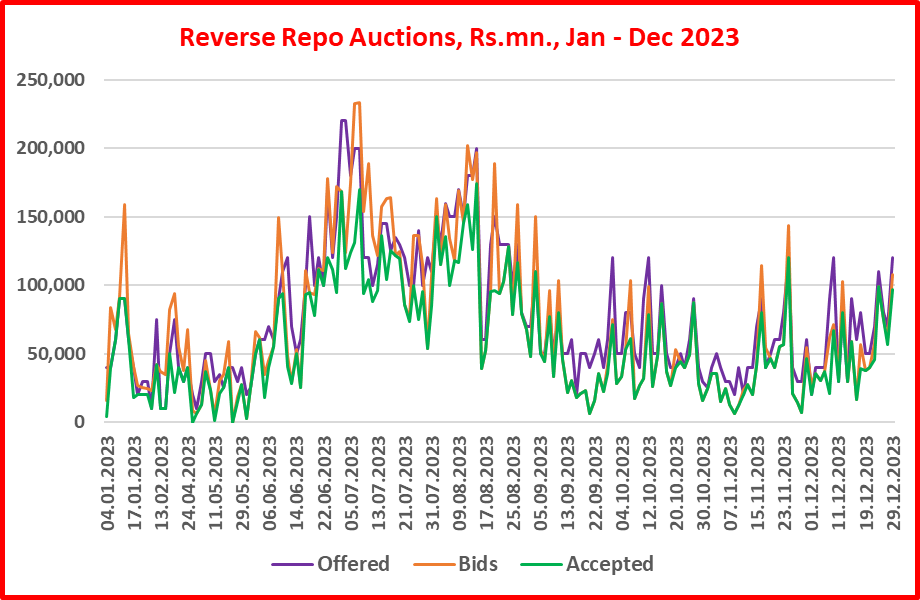
Reverse repos
As standing facilities have not been available to neutralize inter-bank rates, the CB has been abundantly using reverse repo auctions to supply reserves to the banking system in order to serve the job of policy interest rates. In this regard, both overnight and term reverse repos up to a term around 89 days have been offered whereas three auctions have been conducted in some days.
Altogether, 257 auctions with an average of Rs. 54 bn. have attracted an average bidding of Rs. 49 bn with acceptance of an average of Rs. 40 bn. Therefore, data show abundance of offers due to erroneous calculation of the bank demand for reserves.
Given the role envisaged from policy interest rates and standing facilities to target the overnight inter-bank rates, the use of reverse repos to play the same role is highly questionable, especially the criteria, rationale and internal controls used to offer and accept various reverse repos (from overnight to 89 days) and to determine their rates.
For example, the offer of overnight reverse repo rates well below the SLFR despite both facilities are on same terms cannot be explained in economics or finance. As a result, banks have pocketed a profit margin of 40-95 basis points (59 basis points on average) on overnight reverse repos which is a loss to public funds caused by the policy error. Total overnight reverse repos accepted being Rs. 7,389 bn in 2023, the loss is around Rs. 12 bn. Further, overnight reverse repo rates are lower than call money rates too in contrast to inter-bank market repo rates prevailing above call money rates.
In addition, the offer of 7-day reverse repos at SLFR or below does not support the monetary policy in any economics. Accordingly, a loss to public funds exists on total 7-day reverse repos offered amounting to Rs. 1,470 bn. in 2023.
Statutory Reserve Ratio
A SRR cut by 2% to 2% on 08 August was effected to free nearly Rs. 200 bn of reserves to commercial banks. However, its impact on inter-bank interest rates is not recognizable.
The CB’s intension at that time was to drive market interest rates down. However, its failure is evident from subsequent policy rates cuts by 2% in two times and the issuance of monetary order on 25 August requiring banks to reduce interest rates on all credit products.
Purchase of Treasury bills
Up to the restructuring of CB credit (provisional advances and Treasury bills) to the government on 21 September, the CB’s direct subscription to Treasury bill issuances has been the key source to supply reserves to the economy through monetary financing of the budget deficit.
Its key objective has been to control Treasury bill yield rates in line with monetary policy requirements. The Treasury portfolio of the CB is the good indicator of the magnitude of this monetary intervention.
The spike of the Treasury portfolio on 21 September is due to the conversion of provisional advances of Rs. 344 bn into government securities (Treasury bills and bonds). However, the recent reduction in portfolio by about Rs. 100 bn seems to be the prematurely redemption of Treasury bills through proceeds of new borrowing from the Treasury bill market although restructured Treasury bills worth Rs. 220.8 bn are due to mature during 2024.
It is noted that, if not for this source of money printing, the non-availability of adequate monetary reserves would have severely depressed the economy because the CB does not have a safer clientele for lending of reserves in such magnitudes in the present monetary system. Therefore, the CB has to find a new mechanism to supply reserves to banks and the economy when those restructured Treasury bills and bonds mounting to Rs. 2,713 bn mature from 2024 through 2038.
Alternatively, the new CB legislation can be amended to permit lending to the government in line with monetary principles followed by other central banks including central banks in developed countries. Therefore, political authorities have to assess future macroeconomic risks underlying the new CB legislation before the second round of the present economic crisis touches down, given chronic issues confronted in present recovery efforts.
Intra-day liquidity facility
Banks and primary dealers extensively use this facility provided by the CB free of interest repayable within the day to fund their daily liquidity requirements. However, information is not publicly available over the use of facility.
Its significant quantum is evident from 2022 data. Accordingly, a daily amount of nearly Rs. 658 bn has been used.
Overall money printing/reserve supply
Overall position of reserve supply operations through standing facilities and trade of government securities (reverse repos and outright sale) has been highly volatile. Up to September, this mode of reserve supply has been limited due to abundant supply of reserves through CB’s direct purchase of Treasury bills. Therefore, the CB has to expand this mode aggressively as the option of lending to the government has been severely restricted by new legislation and IMF.
Reserve supply operations do not go with the policy rates story. For example, the rate cutting cycle has to go with rising supply of reserves to drive market interest rates down. However, data show a contradiction as reserves supplied on both overnight basis and outstanding/accumulated basis have declined significantly towards the end of the year. Therefore, the governance underlying monetary operations is highly questionable.
Money Market Outcomes – 2023
Inter-bank overnight market (Call money and repos)
The macroeconomic objective of the monetary operations is to stabilize overnight inter-bank interest rates (operating target) within the policy rates corridor. However, some pattern in this direction is seen only from August, but no stability is observed. Further, market repo borrowing rate remaining closer to the SLFR but above unsecured call money rate is a principal issue. Therefore, a clear market aberration is observed due to non-existence of an effective policy rates corridor as a result of capped standing facilities. This raises a concern as to what the present monetary policy model and its macroeconomic role are.
Call money volume has been low mostly below Rs. 10 bn without any trend or stability. Although the same is largely true for inter-bank repo borrowing, irregular spikes are observed as banks have opted to resolve urgent liquidity issues through repos. These banks may be financially weak banks which do not get access to call money due to issues in inter-bank trust. This could be the reason why repo rates remain closer to the SLFR above the call money rate since September.
The low activity in the inter-bank market is a reflection of weak lending conditions in the economy due to the rising bed of non-performing loans and severe macroeconomic contraction. The low profile of inter-bank market activity also indicates the ineffectiveness of the present monetary policy model that targets the inter-bank market for so-called policy transmission across the economy.
Treasury bill market
Treasury bill market has been the clear victim of the monetary operations as it is the main conduit used by the CB to supply reserves while controlling yield rates in line with monetary policy requirements. This is due to the high magnitude and activity of this market as compared to the very low key of the inter-bank market which is the CB’s officially operating target of the monetary policy. Therefore, the de-facto operating target of the monetary policy has been the Treasury bill market. This has not only hampered the financial market development and inclusion but also prevented the fiscal discipline pushing the government eventually to default and bankruptcy.
It is clearly evident how the CB conducts public auctions to manipulate yield rates to support monetary policy cycles. The yield rates significantly were pushed and kept over-shoot above the policy interest rates during the monetary tightening cycle. In contrast, they are kept flat during the easing cycle which does not have a valid monetary policy story other than monetary insider acts. The reluctance to reduce yield rates during last four months is not explainable. In fact, the CB kept yield rates unchanged on 31 May knowing the first policy rate cut of 2.5% same day causing nearly Rs. 5 bn loss to public funds. The acceptance of bids well beyond the amounts announced for auctions and post-auction placement window also have pushed yield rates up unnecessarily. As a result, the cost to the government due to manipulated yield rates is seen largely instrumental in the present plight of the unsustainability of both debt service and tax income.
Risks in terms of cost and rollover are seen significant as the majority of issuances involves in shorter-tenure bills, especially 91D maturity.
Therefore, it is high time that the government takes over the debt management function to ensure its fiscal independence as the CB has miserably failed it causing the debt unsustainability and default. In an insightful analysis, the accounting-based monetary policy that has used government short-term foreign debt, especially international sovereign bonds, development bonds and currency swaps, to finance the import dependent economy is responsible for the present economic crisis.
Monetary Operations in Figures – 2023
The Table below presents selected quarterly statistics of monetary operations and money market outcomes in 2023 for further analysis by readers.
Concerns, Recommendations and Way Forward
Highlights and information presented above raise questions as to who benefits from the present model of monetary operations and what its role is for the bankrupt economy.
Its only benefit is the supply of reserves to wholesale money dealers through reverse repo auctions abundantly arranged to cover up their lapses in liquidity management in the guise of banking/financial stability. Instead, the stability has to come from bank business model risk management and macroeconomic fundamentals. That is why banks confront contagious panics from time to time in front of central banks despite so-called prudent monetary and supervisory policies.
Given discernible irregularities, an investigation is necessary on policy governance and internal controls relating to auctions of Treasury bills and reverse repos with special emphasis on determination of Treasury bill yield rates and reverse repo rates as Treasury bill yield rates have been kept inflated while reverse repo rates have been kept down.
In modern monetary economies, macroeconomic recovery and sustainability are possible only through a wider credit insurance and distribution-based monetary policy model as evident from all developed countries in their historic development path. Therefore, Sri Lanka cannot expect any trickle down effects from the present money dealer-based supply of reserves for the recovery from the bankruptcy. Its only outcome will be the further concentration of economic benefits among those who are blessed with low-risk credit created by banks while pushing the majority of the public into the poverty in the current context of the macroeconomic management system.
Nowadays habit of many national leaders and economists is to plant various stories of macroeconomic recovery and prosperity models. However, nobody reveals or proposes how those models are financed as they don’t bring own funds for the purpose. Therefore, nobody seems to understand the urgent need for reform required to the credit creation and delivery system in line with modern monetary and supply side economics. Instead, every body talks about more and more laws and regulations because they don’t have any idea of how laws and regulations suppress markets and hamper the recovery.
The short analysis above shows that the present monetary operation policy in Sri Lanka is nothing more than a day job of a set of CB bureaucrats subject to several governance concerns. Therefore, the general public cannot expect any benefits from CB’s monetary operations in the new year 2024 and beyond.
Therefore, it is proposed that relevant policy-making authorities seriously consider innovating the country’s monetary system to fund the recovery of the economy across the sectors and activities if they are really interested in the recovery and humanity at least during their generation.
However, despite all highlights, concerns and recommendations presented above, the CB Annual Report for the year 2023 will state that the prudent and forward-looking monetary policy along with policy measures implemented by the government in 2023 have stabilized the economy and brought down inflation to a lower single digit which will facilitate the recovery of the economy in the medium-term under the IMF financial programme.
(This article is released in the interest of participating in the professional dialogue to find out solutions to present economic crisis confronted by the general public consequent to the global Corona pandemic, subsequent economic disruptions and shocks both local and global and policy failures.)
P Samarasiri
Former Deputy Governor, Central Bank of Sri Lanka
(Former Director of Bank Supervision, Assistant Governor, Secretary to the Monetary Board and Compliance Officer of the Central Bank, Former Chairman of the Sri Lanka Accounting and Auditing Standards Board and Credit Information Bureau, Former Chairman and Vice Chairman of the Institute of Bankers of Sri Lanka, Former Member of the Securities and Exchange Commission and Insurance Regulatory Commission and the Author of 12 Economics and Banking Books and a large number of articles published.
The author holds BA Hons in Economics from University of Colombo, MA in Economics from University of Kansas, USA, and international training exposures in economic management and financial system regulation)
January 02, Colombo (LNW): Lanka Milk Foods (CWE) Plc Consolidates dairy business value chain under one company to improve, develop and increase production of fresh milk and milk based products.
The company has concluded a Rs. 5 billion worth shareholding restructuring involving four subsidiaries.
They are Ambewela Products Ltd., United Dairies Lanka Ltd., Ambewela Livestock Company Ltd., and Pattipola Livestock Company Ltd.
LMF has transferred the entirety of shares it owns in the four subsidiaries to Lanka Dairies Ltd., (LDL) a fully owned subsidiary.
This is in pursuance of a proposal to restructure the group of companies under LMF for the purpose of streamlining the ownership and operational structure of the companies within the Group.
Furthermore, the consolidation of the dairy business value chain under one company would improve, develop and increase the production of fresh milk and milk based products.
The related party transaction between LMF and LDL amounted to Rs. 5 billion and the consideration will be settled by LDL through the issuance of new shares in LDL to LMF at Rs. 10 per share. The ultimate ownership of the four subsidiaries will continue to be with LMF.
In the first six months of FY23, LMF Group saw its Group revenue increase by Rs.1.8 billion to Rs. 8.7 billion and operating profit by Rs. 294 million to Rs. 1.2 billion. Post tax profit crossed the Rs. 1.1 billion mark as against Rs. 920 million a year ago.
Of the turnover, liquid milk and others were worth Rs. 5.66 billion. Its profit from operations was Rs. 215 million, lower in comparison to Rs. 727 million by powdered milk, turnover from which was Rs. 2.95 billion in 1H of FY23.
Lanka Milk Foods (CWE) PLC, engaged in manufacturing, packaging, import, and marketing of dairy products and beverages.
January 02, Colombo (LNW): Sri Lanka government is to adopt new strategies and reforms to nourish the participation of Small and Medium scale Enterprises (SMEs) in global value chains, not only to prosper but also to make a meaningful contribution to the country’s recovery and reduce the human toll of the crisis.
Global and regional production chains have been a key driver of economic progress in Asia and the Pacific over the past 2 decades.
In Sri Lanka, SMEs comprise more than 75% of enterprises and account for more than 20% of exports, 45% of employment, and 52% of GDP.
Since their businesses are more vulnerable to demand downturn, disrupted fund flow, shrinking financing, high inflation, shortage of raw materials and fuel, as well as talent migration, SMEs will likely suffer disproportionably in the crisis.
Sri Lanka’s Export Development Board (EDB) completed a comprehensive six-week export coaching program aimed at assisting small and medium-sized enterprises (SMEs) with an export potential, registered under EDB New Exporter Development Program (NEDP).
It is aimed to develop their Export Marketing Plans as the first step in their journey towards becoming export-ready. New Exporter Development Program implemented by the Sri Lanka Export Development Board is aimed at developing export potential of SMEs’ to enter export markets.
The program consisted of three phases. A group of 25 SMEs demonstrating export potential were selected by an internal evaluation panel as the first step of the program.
The second phase involved individual and group training sessions on export marketing planning. A dedicated team of Export Development Board officers, trained by the International Trade Center (ITC) as Export Marketing Plan (EMP) coaches, conducted these informative sessions.
SMEs received guidance from these officers in developing their export marketing plans for a selected product in a target market.
Additionally, there were some knowledge sharing sessions for the SMEs on important aspects on export planning such as packaging development for the export market, marketing and branding, logistics and export documentations with the support of experts from the industry.
The final stage featured an Export Market Pitching program on 5 December 2023 where 17 SMEs presented their export marketing plans, outlining their financial requirement for entry into the international market, such as obtaining market intelligence, quality enhancement, capacity building, packaging development, marketing and branding.
Eventually, Lak Nature International Ltd., Serangreen Holdings Ltd., Saviru Spices and Naturals Ltd., Star Mushroom, Aqua Zone Ornamental Fish Farm Ltd., Cloud Content Marketing Ltd., Jay Ceylon Cinnamon Ltd., Nathuco Brown, Randee Super Food Ltd., and St. Theresa DC Mills Ltd. were selected by the panel as the 10 best export marketing plans.
The winning companies will be assisted by the Sri Lanka Export Development Board to implement their next stage of Export Marketing Plans.
January 02, Colombo (LNW): In an unprecedented turn of events, 2023 saw Saudi Arabia becoming the prime destination for Sri Lankan expatriate workers. Over 63,000 Sri Lankans found employment opportunities in the Kingdom, solidifying Saudi Arabia’s position as the top destination.
This influx not only provided a lifeline to the individuals but also bolstered Sri Lanka’s economy, contributing immensely to the annual remittances of 7-8 billion dollars. These remittances are a vital source of foreign exchange for Sri Lanka, particularly amid its severe financial crisis.
Countries of the Gulf Cooperation Council continue to be a popular choice for Sri Lankan workers. Saudi Arabia, however, stands out, attracting not only general labor but also skilled professionals for its Vision 2030 mega projects.
Every year, more than 200,000 migrant workers leave Sri Lanka to work abroad.They are a main source of foreign exchange for the country, which since last year was gripped by its worst ever financial crisis.
P.M. Amza, Sri Lanka’s ambassador to Saudi Arabia, estimated that in 2023 remittances amounted to over US $7 billion, of which a significant portion was contributed by expatriate workers in the Kingdom.
“During the year 2023, the Kingdom of Saudi Arabia has become the number one country, generating 63,000 employment (opportunities) for Sri Lankans,” he told Arab News on Saturday.
“Of the annual remittances amounting to $7-8 billion a year, a sizable portion has been generated from the Kingdom, which is in the region of 15 to 20 percent of the total remittances.”
Gulf Cooperation Council countries are a preferred choice for Sri Lankan workers, with Saudi Arabia being their key destination, lately also attracting skilled professionals to its mega projects under Vision 2030.
These projects, in addition to a new employment scheme under the Skill Verification Program, were the main factors making the Kingdom increasingly attractive to Sri Lankans, according to Amza.
The SVP agreement signed in March aims to improve the professional competence of employees in the Saudi labor market and ease the recruitment process of skilled workers from the island nation.
Under the deal — which covers 23 professions — Saudi employers recognize accreditations issued by Sri Lanka’s Tertiary and Vocational Education Commission.
“The year 2023 has seen the qualitative and quantitative increase of employment opportunities for Sri Lankans in the Kingdom,” Amza said, adding that while half of Sri Lankan expats have been employed in the domestic sector, this year showed growth in the number of those working in the construction and hospitality sector.
“The signing of the agreement on the Skill Verification Program between the two countries has also contributed to this increase of skill and professional categories of employment, which stood at nearly 12,000 during 2023.
January 02, Colombo (LNW): The construction industry in Sri Lanka has been expected to contract by 14.9% in real terms last year, down from the previous estimate of a 7.9% decline, owing to the ongoing economic and political crisis, a steep currency depreciation and rising inflation.
The Sri Lankan construction industry is set to register an average annual growth of 5.6% from 2024 to 2027, picking up from the low base in 2022 and 2023.
The construction sector saw its contraction continue in November too as per the Purchasing Managers’ Index (PMI) compiled by the Central Bank.
It said the Construction PMI recorded a Total Activity Index value of 44.3 in November 2023, indicating a contraction in construction activities compared to last month.
“The respondents mentioned that the low level of new projects and the decline in work related to ongoing projects, as they are in the final stages, hampered the activity levels,” CBSL said.
It said new orders declined at a higher pace in November compared to the previous month. However, many respondents expect an acceleration in awarding of projects, especially Government-funded projects in the first half of the next year.
Employment continued to contract as the companies tend to operate with minimum staff under the current industry situation. Further, the quantity of purchases declined in line with the decrease in construction work. Suppliers’ delivery time remained lengthened during the month.
CBSL said the industry outlook for the next three months is positive, mainly in anticipation of the increased demand from the next year, together with favourable weather conditions.
However, the firms are concerned about the upward tendency in material prices due to the announced tax revisions.
Sri Lanka’s construction industry is down but falling material prices are helping start small-scale work and there was hope of government backed project re-starting later in the year according to a Purchasing Manager’s Index.
“The lack of new projects continued to hinder the industry, which is reflected by the continuous decrease in New Orders,” the central bank which compiles the index said.
“The respondents mentioned that sizable projects are hardly available, except some foreign-funded projects, and the bidding for available tenders is also highly competitive.
However, they expect the suspended large-scale projects to gradually recommence later in the year.
“Further, Employment remained contracted in June, mainly due to the layoffs after project completions.
Moreover, Quantity of Purchases declined in line with the decrease in pipeline projects. Meanwhile, Suppliers’ Delivery Time remained shortened during the month due to low order quantities.”
Sri Lanka government projects are suspended pending re-structure of defaulted debt.
January 02, World (LNW): In a tragic turn of events, Japan reports the loss of at least 30 lives in the aftershocks of the powerful earthquake hit the country yesterday.
The casualties resulted from the collapse of various structures, including residential homes and office buildings.
The figures may rise in later reports, as rescue teams are already in operation in search of survivors and casualties.
The seismic activity also triggered a minor tsunami along several coastal areas of Japan, prompting authorities to issue tsunami warnings.
Fortunately, the warnings have now been lifted, bringing relief to the affected regions.
Rescue and search operations are currently in progress to locate and aid individuals trapped in the debris caused by the earthquake.
Emergency response teams are working tirelessly to navigate the aftermath and provide assistance to those affected.
On a positive note, it has been reported that the Japanese high-speed train, initially halted as a safety measure, has resumed its operations.
As the nation grapples with the aftermath of this seismic event, the focus remains on the ongoing rescue efforts and providing support to those affected by the tragedy. Authorities continue to monitor the situation closely and ensure the safety and well-being of the affected communities.
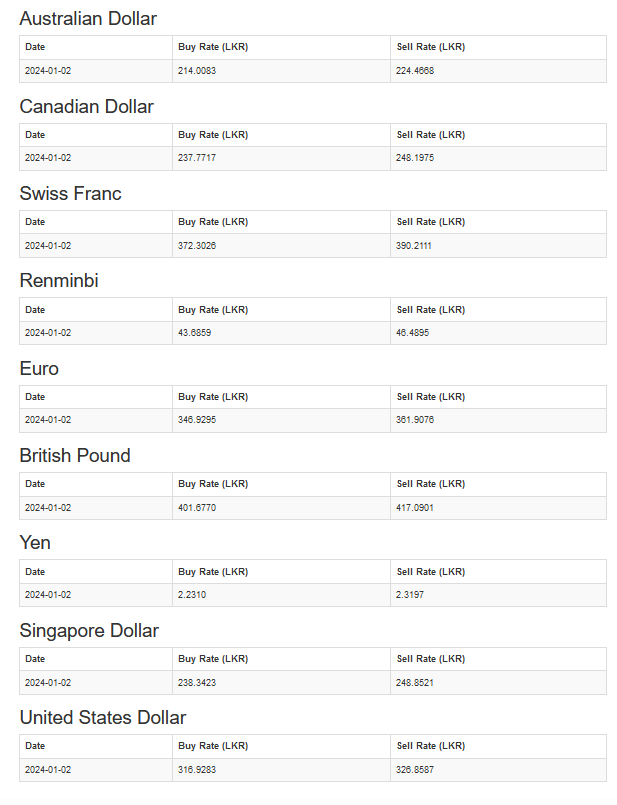
January 02, Colombo (LNW): The Sri Lankan Rupee (LKR) has largely appreciated against the US Dollar today (02) in comparison to yesterday, as per the official exchange rates released by the Central Bank of Sri Lanka (CBSL).
Accordingly, the buying price of the US Dollar has dropped to Rs. 316.92 from Rs. 319.23, and the selling price to Rs. 326.85 from Rs. 328.77.
The Sri Lankan Rupee has also appreciated against several other foreign currencies.
January 02, Colombo (LNW): The Ceylon Electricity Workers’ Union has reportedly declared its intention to initiate a three-day protest starting tomorrow (03) against the proposed Bill aimed at restructuring the state-owned Ceylon Electricity Board (CEB).
The protesters’ primary demand during the protest would be the immediate withdrawal of the Bill by the Minister of Power and Energy, Ranjan Jayalal, Chief Secretary of the union, emphasised.
He expressed concerns about the potential repercussions of the proposed restructuring, asserting that Minister Kanchana Wijesekara wants to sell this off together with the President and warning that the CEB workers will go for a massive strike action, were the bill to be passed arbitrarily in Parliament.
Simultaneously, Ratna Gamage, the national organiser of the All-Ceylon Fisheries Federation, voiced concerns about the new Fisheries Act, highlighting the crisis it has brought upon their industry.
January 02, Colombo (LNW): In the early hours of Tuesday (02), a devastating incident occurred at a warehouse situated in Point Pedro, Sea Beach Road, Munei, resulting in the tragic loss of two lives.
The fire originated within a rigifoam box and plastic warehouse primarily utilised for fish packaging, Police said.
The victims, aged 37 and 45, were residents of the Lomantwatta area in Udupussellawa and were employed in the fish processing sector.
As of now, the exact cause of the fire remains undisclosed.
The Point Pedro Police are conducting further investigations into this unfortunate incident to ascertain the circumstances leading to the fire and the subsequent loss of lives.