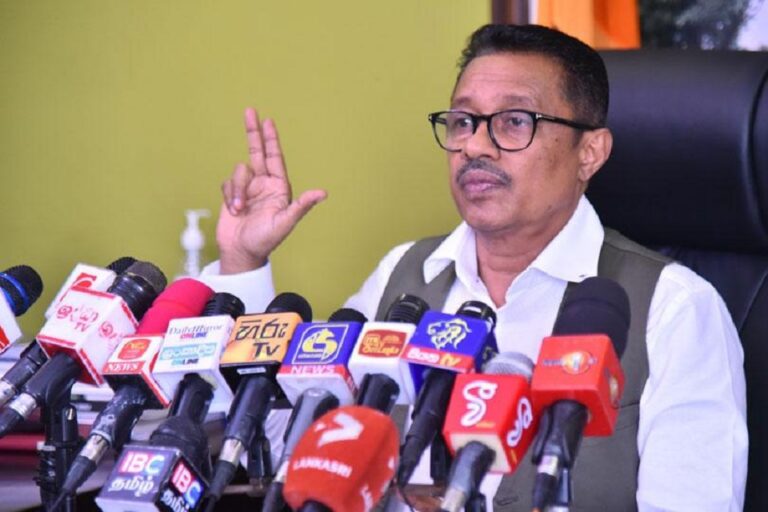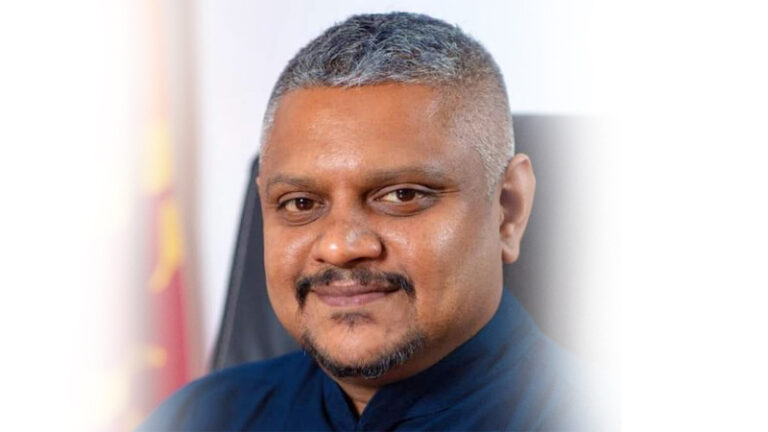
- President Ranil Wickremesinghe says Sri Lanka has a very competitive tea industry: also says it needs to be modernized.
- Speaker Mahinda Yapa Abeywardena signs the 21st Amendment to the Constitution.
- Department of Census and Statistics says the overall rate of inflation as per CCPI on Y-o-Y basis has decreased to 66% in Oct 2022 from 69.8% in Sep 2022: Food inflation down to 85.6% from 94.9%: transport inflation dips to 144.2% from 150.4%.
- SLPP MP Namal Rajapaksa says SLPP will support President Wickremasinghe although they are in separate political parties: admits differences when considering policies: explains the two sides will try to meet halfway to fulfil the needs of people in the country.
- SJB MP Lakshman Kiriella says his party is demanding a Parliamentary Election: says the current Government is well past its expiry date: points out that many MPs have left their fold and now to sit with the Opposition instead.
- SriLankan Airlines Chairman Ashok Pathirage says the SLA plans to earn USD 600 mn from the sale of stakes of SriLankan Catering Ltd. and the airline’s ground handling unit: hopes to thereby reduce SLA’s debt by half.
- Ministries of Transport and Energy together launch website www.wptaxi.lk to register passenger transport Three-wheelers in the Western Province for the 10 Litre weekly fuel quota.
- Police fire gunshots onto the air to disperse a crowd during a tense situation in Rambakepuwewa, Kebithigollewa in Anuradhapura: one Police officer injured.
- Ministry of Finance admits the new 2.5% Social Security Contribution Levy will apply to all State-owned utility service providers including CEB, CPC and NWSDB: levy likely to be passed to the consumer.
- Softlogic Stockbrokers Head of Research Mahesh Udugampola says corporate earnings expected to rise 30% YoY in 2022, down from the 80% increase in 1H22: predicts corporate earnings would reduce by 20-25% in 2023.
Sri Lanka Original Narrative Summary: 01/11
Southern Farmers to Be Ready to Ride the Current With FO4A (Suhuru Govi) Project
On the 18th of October, a training was organised for the leaders of farmers organisations and cooperatives who are attached to the 8 collective businesses, incubated with the guidance and assistance of SEFEC, under the Farmers for Asia (Suhuru Govi) project.
The objective of the training was to educate the leaders about the policy and regulatory context within which they would have to operate their businesses and the challenges and way forward as small holder farmers in the current economic crisis.

The training was held at Samanmal hotel with the attendance of 50 people, representing two districts of Southern province, Hambanthota and Mathara. Mr. Chinthaka Rajapaksa, Mr. Chaminda Paragodaaarachchi, Mr. Shantha Devapriya, Mr. Siriweera Nikathenna and and Ms. Smadani Kiriwandeniya were resource persons of the training.
The training was organised by Mr. Sisira Chaminda, the Enterprise Development Officer of SANASA international.


Ambassador Samarasinghe presents credentials to the Organization of American States
Ambassador of Sri Lanka to the United States, concurrently accredited to Mexico, Trinidad and Tobago Mahinda Samarasinghe met with Secretary-General of the Organization of American States (OAS) Ambassador Luis Almagro, on Friday, 28 October 2022, at the Organization’s Headquarters in Washington DC. He presented letters of credence as a permanent observer to the Organization, one of 71 countries with this status. During the interaction with the Secretary-General (a former Ambassador, Foreign Minister and Senator from Uruguay), the Sri Lankan Ambassador briefed him on the steps being taken by the Government of Sri Lanka to overcome the present economic challenges and the progress achieved to date.

The Ambassador adverted to Sri Lanka’s relative lack of resident diplomatic representation in OAS countries with only four Missions operating in the 35 member states (United States, Canada, Brazil and Cuba). He inquired of the Secretary-General if Sri Lanka could use the good offices of the OAS to expand and strengthen ties with the other states, to which the response was encouraging and positive.

The potential for further enhancing trade with OAS countries was also mentioned during the discussion. The Secretary-General welcomed such initiatives. Ambassador Almagro was also invited to visit Sri Lanka and the Secretary-General responded positively to the proposal.
Permanent Observers attend the public meetings of the OAS General Assembly and the Permanent Council and of their principal committees and, when invited by the relevant presiding officer, the closed meetings of those bodies. They also receive the documents and publications of the Organization and are invited to attend specialized conferences and other meetings convoked by the OAS. The Permanent Observers provide cooperation, in the form of training opportunities, expert services, equipment, and cash contributions for various OAS programs. OAS cooperation with Permanent Observers includes: financial contributions dedicated to particular projects and priority areas; technical assistance, professional training opportunities, and sharing of best practices; as well as academic scholarships.

Among the main benefits accruing from Permanent Observer status are: The OAS offers a unique forum to strengthen relations with all Member States in one place and can serve as an effective cooperation facilitator, in particular for Permanent Observers that do not have a presence in all countries of the Western Hemisphere. As the main political forum for the convening of government authorities and stakeholders at the Inter-American level, Permanent Observers benefit from a more effective direct engagement and visibility among OAS Member States. In-depth knowledge of country needs, in particular of smaller countries and regions at the sub-national level where Permanent Observers may not have a direct diplomatic relationship or presence. The OAS presence with national offices in the entire Hemisphere allows Permanent Observers to interact at the local level through their Embassies.

Officers of the OAS Headquarters and diplomatic staff of the Embassy of Sri Lanka also were associated in the meeting.
Embassy of Sri Lanka
Washington DC
31 October, 2022
General Amnesty Declared for Tri Service Absentees
All tri service members who have been absent without leave (AWOL) by 25 October 2022 or before that date can receive a legal discharge from their respective services under a general amnesty period declared by Ministry of Defence (MOD), effective from 15 November 2022, an MOD Media Release stated.
The general amnesty period ends on 31 December 2022 and those absentees before their discharge should settle any dues repayable to their respective service. The period of general amnesty will be in force from 15 November 2022 until 31 December 2022, the Release added.
MOD
SLASSCOM ties up with INT@J in Jordan
Under the aegis of the Embassy of Sri Lanka in Jordan, an MoU between SLASSCOM and INT@J was signed on 27 October, 2022. The MoU signing took place virtually between Chairman Ashique M. Ali on behalf of the Sri Lanka Association for Software and Services Company (SLASSCOM) and Chairman Amjad Swais for INT@J in the presence of Sri Lanka’s Ambassador to Jordan Shanika Dissanayake, CEO of INT@J Nidal Bitar and the membership of both Associations.
Under the terms of the MoU both parties will mutually collaborate to explore opportunities and investments and to maximize the outreach for networking for the ICT/BPM companies in their respective Associations. SLASSCOM under the guidance of its Chairman Ashique Ali will be hosting the B to B sessions shortly in order to maximize on potential areas for collaboration that are expected to open up for Sri Lankan software companies through this MoU.

Ambassador of Sri Lanka to Jordan Shanika Dissanayake stated that the signing of the MoU will open up avenues for the members in both SLASSCOM and INT@J to enter the entrepreneurial eco systems in Sri Lanka and Jordan. As digital transformation is a key pillar towards improving a business environment and attracting foreign investment, the MoU is expected to stimulate creativity in the different verticals of the software industry, particularly for Sri Lanka.
Embassy of Sri Lanka
Amman
31 October, 2022
Many opportunities at Construction Sector in Saudi Arabia: Foreign Employment Bureau
In the existence of many career opportunities for Sri Lankans at the Construction Sector in Saudi Arabia, the Foreign Employment Bureau of Sri Lanka has initiated a programme to gather information on qualified Sri Lankans who are expecting of receiving professional career opportunities in large-scale construction projects in the Middle-East country.
Accordingly, the Embassy of Sri Lanka in Saudi Arabia and the Sri Lanka Foreign Employment Bureau are planning to hold negotiations with the Saudi authorities in this regard.

These career opportunities include vacancies for architects, engineers and quantity surveyors, and eligible Sri Lankans, accordingly, have been encouraged by the Bureau to visit the ‘Identification of Qualified Professionals for the Construction Sector in KSA‘ web portal, by visiting the Bureau’s official website, www.slbfe.lk before November 05, 2022 and to provide details.
MIAP
President emphasises modernisation of SL’s competitive tea industry
The government is aiming at an agricultural modernisation programme in which tea will be of importance, for the country has a very competitive tea industry that needs to be developed, said President Ranil Wickremesinghe, addressing the 32nd Annual General Meeting of the Sri Lanka Tea Factory Owners Association at the Water’s Edge Hotel yesterday (30).
The Full Statement by the President:
“I was listening to the report by your president about a survey of the tea industry today. He came out with a tale of woes. That is understandable looking at what we have gone through this year. Now, it is my chance to come out with my tale of woes because I have taken over the titanic after it hit the iceberg. So you can just imagine where I have to start. Everything was down.
We have declared ourselves bankrupt. What have we got to do? First is to ensure that people can live and there is enough food to eat, whatever the other difficulties. With the bankruptcy that we have declared, our economy has virtually come to a halt. The inflation, the bankruptcy, and everything else that is happening have brought our economy to a grinding halt.
How do we restart it? That is what we are engaged in. In addition, I thought I’d explain to you the process. Primarily, we have to conserve whatever foreign exchange we have and limit imports so that we could get fuel, fertiliser and medicine.
It has not worked fully initially, but now it’s working much better. Therefore, that is how we started. Then as the revenue dried up, we faced the difficulty of paying our bills or meeting our commitments. We had to keep two things in mind, one is to pay the salaries of government servants, about 1.7 million people and service our debts. Therefore, we have had to work within this scope.
Now that we have declared ourselves bankrupt, the first issue was to ensure that the world would now accept that we have taken sufficient steps to wipe out the label of bankruptcy, which meant that we have to go to the IMF and discuss with them. Every country and organisation wanted us to meet with the IMF and devise a plan.
We did have a plan until 2019 when we cancelled the last year. Therefore, we had to start original discussions with the IMF. We had no other option. Our growth rate this year is going to be -8%. Last year too we recorded minus growth. This year is also -8%, and next year it is forecast that it would be -3%.
However, there’s one other factor which worries me. When that forecast was made, everyone thought the global economy will do well. Now, all the indications are that the global economy will fair badly. How will it impact, because the rising inflation in European and other countries will mean that the cost of living will rise? This in turn can somehow affect exports such as less clothing, maybe less tea, and less coffee. We have to understand that.
Therefore, we have to get through this year and then go into next year. Hence, we have to somehow manage two years. Our revenue reduced from 15% to 8.5% and we are expected to get the revenue back to 15%, which I think we have to do.
The timeframe is 2026. I went in for a four-year program. I didn’t think we could bear the burden if we tried to do it in two years and it may not have been possible. I’m happy that we went for four years because 2023 looks to be a bad year globally, not only for Sri Lanka.
So we had to first come to an arrangement which meant raising money. To raise that money, we had to tax everything, which also meant agriculture.
As someone once said, if it moves tax it. We had to come to that level and we had no way out. I wish we could have done it gradually but couldn’t because we needed the money. If you look at the taxes, those who paid taxes up to 2019 got a reduction in 2019. Therefore, that’s a loss of revenue. Now what we are trying to do is bring it back first to the 2019 level and add a little bit more. So if you look at up to 2019, your taxation then and today is one figure. However, if you look at 2020 the gap seems much bigger. The fact is that we are suffering, it’s not only tax, but our rupee has also depreciated and interest rates have gone up.
Therefore, it is in this context that we have to operate. Ordinary people are finding it very difficult to live. I mean it’s in that condition that we have to come back. So the first issue is to ensure that we can restructure bankruptcy. We have to start talks with our creditors. I first went to the Paris Club where all the creditors were from the West and Japan.
However, we are in a unique position today where out of our three main creditors, only one belongs to the Paris Club. Japan. The other two are not in the Paris Club. They are India and China. I mean China only started dealing with bankruptcy in Zambia. I think India has it for the first time with Sri Lanka. I have already started discussions with Japan and now with India and China. We get down to a common platform of how we can resolve it while we also have discussions on bilateral issues that affect each other’s countries.
Now, this is the process, we had to move. If we can move and come to an agreement by December, which means coming to an agreement by mid-November, and going up to the IMF Board in mid-December, we will gain a big advantage. However, I don’t know whether we can do it for the simple reason that in China, the focus has started now after the party conference. However, we must aim to have it by January.
Therefore, this is what we are aiming at, and it means that we have to show that we have the revenue and we can go ahead. We start from there. Then how do we go ahead to ensure next year is better? In the meantime, we have started receiving assistance from many organisations and countries. Some countries have helped us through different organisations.
So thanks to the World Bank, ADB and others, we are having FAO, and we are having enough fertiliser. Even countries like the US have assisted us. So the fertiliser issue is solved. No one will give us money for fuel. Hence, we have to use the savings on fertiliser with local foreign exchange to buy fuel.
The next issue though, is that the price of fuel has dropped now and everyone expects the price of fuel to increase in December/January due to the Ukraine war and winter. Hence, that’s the next issue that we have to face. But since we have received fertiliser, the first thing was to revive agriculture, starting with Paddy and then getting on to tea and other crops.
Therefore, this is one part where if we get a good Maha crop by March/April next year, that will help to stabilise the economy. Meanwhile, once we get the agreement, the countries will come to help us. However, it takes time to get loans from bilateral loans again. Meanwhile, the World Bank and the ADB are willing to come up with bridging finance and the whole process will start.
Therefore, we have to thirdly go all out to improve our tourism. I think if we can aim for good tourist numbers by December next year as it grows progressively, then it will start working. Finally, we need foreign exchange reserves. There is no way in which you can raise it now. The only way in which we can raise foreign exchange reserves is by selling off some of our enterprises for dollars so that we can at least put $ 3-4 billion into the reserve, strengthening the rupee further. It will make life that much more affordable if you are moving to a complete market economy and a high-growth economy. This is the only step that we can take because so far having a vast state sector did not enable the economy to grow that fast.
I know the problems you have and I know many of you in the tea sector. Factory owners as much as in the rubber, coconut sector construction sector and the hotel sector are having problems with your banks, servicing your loans etc. So that’s why we are hoping first to bring the rate of interest down gradually.
The Governor of the Central Bank has informed us that our inflation is peaking. So by about February or March, we can see the reduction of interest rates, if not earlier. If we take all these measures by mid-year, we’ll be able to give relief on the interest rates. It’s difficult when the rupee has depreciated and the interest rates rise. But you have to remember that in two years we printed Rs 2.5 trillion worth of notes. So it has to run through the system.
There is no shortcut and the only way is by getting production up again. So here it’s a question about how we could help you in the tea industry. We have got the fertiliser. I know there are deficiencies in other areas. One of the main things that I asked is that we pay the fertiliser suppliers. We have decided to pay them, but the money hasn’t gone yet.
I hope that with the new taxes and the collection that is coming in November-December we will be able to pay them off. We also have to pay the contractors. The whole industry has come down. So there’s a long list of people with debts which the government has to honor. So that’s the process. But we want the tea industry to develop. And I must assure you, the honorable minister and the State Minister have been spending a lot of their time looking at how to help you in this circumstance.
Because helping the tea industry helps us bring in foreign exchange and save rubber and additional agriculture production. Next year we have to come through with agriculture production. That is what we have to do as we add the rupee stabilises. Certainly, people will start sending back the exchange, the foreign employment and the money will come up. But also we can’t run on this economic model anymore.
We have to pay our debts. We have to take some more debt. We are to work completely on an export-oriented economy, and that’s what we are working on. We’ll come back to you, but you have a lot of things to do too. We know you need fertiliser. Most of the major issues are that we need replanting. We are suffering because we have not replanted. As a result, our crop per hectare is coming down. Vietnam is overtaking us. Whoever thought that Vietnam will be growing tea? That’s the position. So we are looking at an agriculture modernisation program in which tea will have a big place.
We have a very competitive tea industry that we have to develop. And I think we have to go for quality tea, whether it be high-grown or mid-grown. It is useless for us to keep competing with those who are not having the quality.
We have an opportunity. Let’s go for it and develop the industry, modernise our factories, and look at renewable energy, biomass, and all that is there. So we need a modern industry and certainly, I think it’s good that you have got Price Waterhouse and Cooper. Because you can utilise their report together with the ADB report on the regional plantation companies. Some of you are doing quite well. Others are a disgrace. So let’s see how we can restructure, how we can get your help and go ahead. I thought I described this to you. I haven’t got the best picture possible, but at least I am trying to take the Titanic off the iceberg and once we do that, we’ll go ahead. Thank you very much for inviting me”.
Plantation Industries Minister Ramesh Pathirana, Chief Executive Officer of A. Baur and Company (Pvt) ltd Rolf Blazer and President of Sri Lanka Tea Factory Owners’ Association Lionel Herath also addressed at the occasion.
State Minister Lohan Rathwatte, UNP Leader and Parliamentarian Vajira Abeywardena, Plantation Ministry Secretary B. L. A. J. Amarakeerthi, Sri Lanka Tea Board Chairman Niraj de Mel and office bearers and the members of the Sri Lanka Tea Factory Owners’ Association participated in the event.
Prices of bakery products slashed
The prices of all bakery products will be slashed by midnight today (31) concluded the All Ceylon Bakery Owners’ Association.
Accordingly, the price of a 450g loaf of bread will be slashed by Rs. 10, and the price of all other bakery products, Rs. 10 as well.
MIAP
Netherlands extends further support for SLs “Grow More Food” program
The Netherlands has assured to extend further support to Sri Lanka especially with know-how to the Government’s “Grow Food” program.
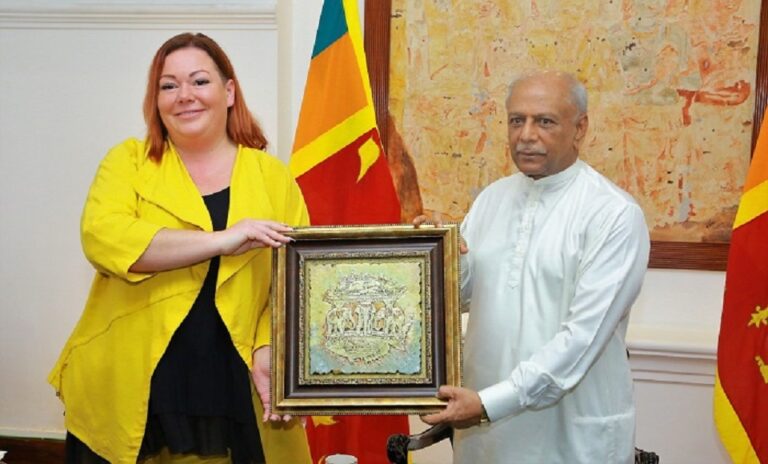
This assurance was given by when Netherlands Ambassador Bonnie Horbach called on Prime Minister Dinesh Gunawardena on Thursday.
The Premier thanked the Netherlands for the assistance provided to infrastructure development and agriculture and various other sectors and urged for technical know-how and more investments in agriculture, information technology, renewable energy, transport and tourism.
Horbach said Sri Lanka has vast potential in many areas including information technology, tourism and agriculture and she was confident that her country would undertake more projects once the global economic situation gets over the current difficult phase.
The Prime Minister explained the ‘Grow Food’ programs undertaken by the Government at 14,000 Grama Sevaka divisions and said that in addition to the Maha season of paddy, cultivation of many other crops in hitherto uncultivated lands is likely to provide a good yield by the first quarter of next year.
Ambassador Horbach said her country has advanced in innovative agro technology and the Netherlands expertise could be provided to Sri Lanka. She said that the Netherland scientists have developed a new variety of potato that can grow in salty lands as most areas of her country is closer to sea and the land consist of saline water and that potato seeds could be provided to Sri Lanka to start potato cultivations in areas close to sea, especially in the north and east.
They also discussed other areas for collaboration, including climate change, trade and commerce, ports development and joint projects.
The new Netherlands Ambassador assured the Prime Minister her prime task would be to promote bilateral ties and development cooperation during her tenure in Sri Lanka.
The government of the Netherlands has shown interest in cooperating with Sri Lanka in areas of sharing agricultural technology, promoting Dutch tourism into the country and possibility of buying coconut oil for food processing industries in the Netherlands.
The focus was primarily on the possibility of implementing new projects related to agriculture between the two countries aimed at getting high results by mixing the traditional agricultural practices of Sri Lanka with the modern techniques available in the Netherlands.
The two sides focused on the promotion of tourism related to plantation industry and agriculture. Apart from that, ideas were also exchanged regarding Sri Lanka’s future program of reducing the use of chemical fertilizers and using organic fertilizers.
It was also discussed to prepare a method to import Sri Lankan coconut oil for various industries in the Netherlands, especially in the production process of various foods including chocolate.
It was also discussed about bringing Dutch tourists to Sri Lanka for the promotion of the tourism industry in Sri Lanka.
The Ambassador expressed belief that Sri Lanka, which is inhabited by people with a very high level of education and information technology skills, will soon be able to return to its previous status as a middle-income country with the support of the International Monetary Fund.
Sri Lanka launches marine cage farming with Global Ceylon SeaFoods
Sri Lanka’s seafood industry is eyeing a target of US $ 1 billion in seafood export revenue with major local sea food exporting companies are expanding its vlaude added production for the export market.
Under this initiative, Global Ceylon SeaFoods (Pvt) Ltd., leading seafood exporting company in Sri Lanka inked an agreement with the Board of Investment (BOI) to set up a sea cage farming project for the export market in Trincomalee, for an investment of US$ 7.5 Mn.
The agreement in this regard was signed in the presence of Investment Promotion State Minister Dilum Amunugama, BOI Chairman Raja Edirisuriya, Director General Renuka M Weerakone and Global Ceylon SeaFoods Director Per Marius Arntsen at the newly unveiled Investor Facilitation Centre (IFC) on Friday (28).
The newly signed project is to generate nearly 100 employment opportunities.
Global Sea Foods (Pvt) Ltd, known simply as GSF is a leading seafood processing company based in Sri Lanka.
The company is a BOI approved venture established in 1999, that supplies the high quality Value Added Sea Food products to destinations such as Europe, USA, Middle East and Japan to name a few. GSF can be identified as a significant source of foreign exchange income earner in Sri Lanka
Speaking at the occasion, State Minister Amunugama said,” This marks the first agreement to be signed at the IFC, which was set up to expedite and streamline investment approval process while strengthening the coordination with respective line ministries,”
Seafood Exporters’ Association of Sri Lanka (SEASL) revealed that seafood exports were estimated to have, a growth of 24 percent compared to last year.
It announced that two varieties of Sri Lankan fish recommended, for the first time ever, to consumers, retailers and to the global seafood industry as a good alternative by North America’s leading seafood rating agency for sustainable practices, Monterey Bay Aquarium Seafood Watch.
Blue swimming crab in the Gulf of Mannar and in Palk Bay was moved from a red ‘Avoid’ ranking to a yellow ‘Good Alternative’ rating by the agency, following the implementation of parallel Fishery Improvement Projects (FIPs) which was targeted at influencing fishermen for more sustainable practices, through an investment of US $450,000 made by various international and local organisations.
These were also the first fish type in Sri Lanka and the only blue swimming crab category in South and South East Asia to be recommended by Seafood Watch.
According to SEASL , the final export destination for Sri Lanka’s 90-99 percent of sea crab is United States, while Singapore remains as a major export market for lagoon crab.
With new rankings, Sri Lankan exporters will be able to get premium prices, and with the exporters paying more to fishermen, more fishermen will resort to crab farming.
It emphasized that the industry would focus more on shrimp farming to reach the US $1 billion export target in three years.
Sri Lanka has a pilot project ongoing in a 50-acre land in the Northern Province; it will be soon go into the commercial stage.
Sri Lanka will be able to boost its shrimp yield by nearly tenfold from the current yield, once the project reaches the commercial stage.
The government already has given the seafood industry a 500-acre land in the Northern Province for shrimp farming, and said that there will be more land available for the private sector.