Home Blog Page 1925

Ex President Rajapaksa advised not to leave hotel in Bangkok

0

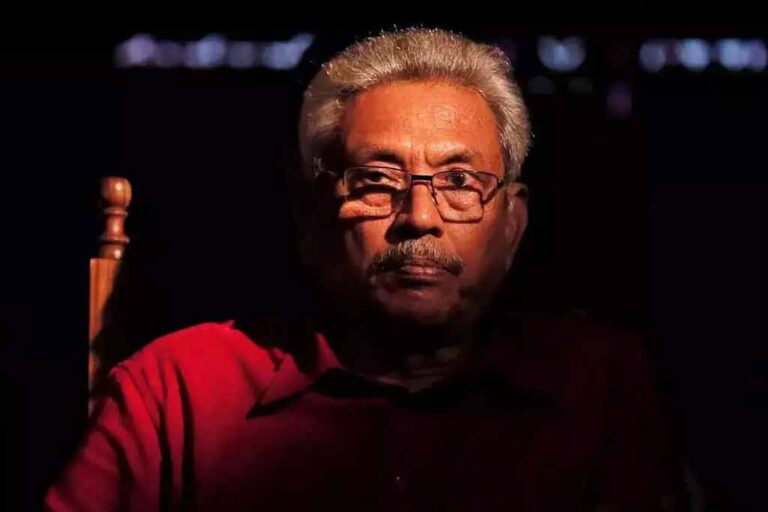
Gotabaya Rajapaksa, the ousted former President of Sri Lanka, is currently staying at a hotel in Bangkok and is advised not to leave due to security reasons, foreign media claimed.

The former Sri Lankan President arrived in Bangkok with three other people on a chartered flight from Singapore at Don Mueang International Airport two days ago.

The name of the hotel is not disclosed to media and security officers in plain clothes are deployed for his security, according to reports.

Officials have asked the former leader to remain within the hotel during his stay in the country and the country’s Prime Minister noted that Rajapaksa would be allowed to enter Thailand on humanitarian grounds but would be advised to keep a low profile, reports added.

MIAP

The struggle of the Relatives of the Disappeared marks 2000 days!

0

The ongoing Struggle of the Relatives of the Disappeared, including the mothers of the North and East and reportedly the longest struggle in the history of Sri Lanka demanding the government to reveal the fate of their loved ones who disappeared during and after the 30 year-old war, marked 2000 days yesterday (12).

Marking the 2000th day of the Struggle, a protest march was organised from in front of the Kilinochchi Kandasami Kovil to the Depot Junction.

The North East Association of Relatives of the Victims of Enforced Disappearances, which strongly denies the acceptance of compensations and death certificates for their loved ones, including the victims of enforced disappearances and the children who were handed over to the Army during the end of the war, demands the government to immediately disclose their fate and the parties responsible for their disappearances.

The protesters revealed that 128 parents who had been continuously on the protest ground of the 2000 day Struggle passed away without learning the fate of their children. Many of the protesters including mothers and relatives of the victims had been subject to harassment on numerous occasions by the Police and the Military, they added.

MIAP

India’s External Affairs Ministry issues statement on controversial Chinese Defence Vessel (VIDEO)

0

India’s External Affairs Ministry denied all media reports claiming that it had pressured Sri Lanka not to allow the controversial Chinese space observation vessel to enter the Hambantota Port.

Speaking to a briefing yesterday (12), Spokesperson for the Indian External Affairs Ministry Arindam Bagchi made it clear that Sri Lanka is a sovereign state and so it can take independent decisions. Concerning security, the matter is related to the sovereign rights of each country, he added.

MIAP

Panduka Keerthinanda appointed as Legal Officer for Sri Lanka Rugby Administration

0

Panduka Keerthinanda, a veteran legal expert, the Chairman of the Sugathadasa National Sports Complex Authority, a member of the National Sports Council and an individual of vast experience in various professions related sports in his capacity as the Legal Advisor to the Ministry of Sports during the period 2010 – 2015, has been appointed as the Legal Officer for the Sri Lanka Rugby Administration, as decided by the Council.

Keerthinanda, who is currently serving as a legal counsel for Minister of Tourism and Lands Harin Fernando, has directly been instrumental in bringing about amendments to the Sports Act such as the Convention Against Doping in Sports Act No. 33 of 2013 and the Prevention of Offenses Act relating to Sports Act No. 25 of 2019.

The Sri Lanka Rugby Administration faced severe legal obstacles in the recent past and a great effort had to be put to the restoration of the men’s and women’s teams in the Commonwealth tournament amidst a restraining order brought in by the former subject Minister and temporarily removed by the Court.

Keerthinanda may have to deal with the forces against Rugby by supporting the Administration which is putting its efforts to add certain amendments to the sports law as well as to prepare for the intervention of the objections rising in the manner of fire under ashes against the sport.

Rishivi Illiyas, President of the Sri Lanka Rugby Administration, told LNW that as a person with a passion for sports and as a person with experience and knowledge of civil law and sports law, Keerthinanda would be able to control and eliminate the rising forces that are trying to evade the sport of Rugby from its path to success.

MIAP

Opposition Leader condemns unusual surge in electricity tariffs, calls it ‘electrocuting’

0

The unusual surge in electricity tariffs has severely inconvenienced the people of this country and the move may not be tolerable, said Leader of the Opposition Sajith Premadasa, speaking in Parliament yesterday (12).

Pointing out that the move is severely affecting from the ordinary people to the industrialists, the Opposition Leader stressed that this would be another burden on the people who are under extraordinary pressure amidst the current situation.

MIAP

Court denies former Ambassador Weeratunga’s request

0

The Fort Magistrate yesterday (12) denied a request made by former Sri Lankan Ambassador to Russia Udayanga Weeratunga to temporarily lift his overseas travel ban, as the motion filed by the Rajapaksa relative to obtain permission to leave the country for a trade seminar was taken up yesterday.

The overseas travel ban was imposed to Weeratunga in connection with the notorious MIG deal, and the Criminal Investigation Department (CID) appearing in the Court pointed out that any approval for him to leave the country would make his return to Sri Lanka uncertain, given that he had already evaded the Court by violating the ban during the period of 2015 – 2019.

Considering the facts, the Fort Magistrate Thilina Gamage denied Weeratunga’s request.

MIAP

Government resorts to domestic debt restructuring surgery

0

Sri Lanka Government is now resorting to restructure domestic debt to overcome fiscal and economic stress

Restructuring domestic debt is like surgery:“You only do it if you must, and you avoid it if it might do more harm than good” , the International Monetary Fund clarified in a recent report.

On the one hand, domestic debt restructuring may be easier to accomplish. Authorities can, for example, simply elect to alter the terms of debt contracts through changing domestic law.

On the other hand, domestic debt is often held predominantly by domestic creditors who will suffer losses.

Through this channel, sovereign debt distress can easily spread to domestic banks, pension funds, households and other parts of the domestic economy. This can add to the economic malaise that made the debt restructuring necessary in the first place.

So the government is now ina catch 22 situation caught up between options of Domestic Debt Restructuring or not. , he said adding the President is determined to take the risk.

Sri Lanka should not pave the way to create a banking crisis in attempting to reduce government debt by imposing haircuts on rupee debt in a bid to reach debt sustainability, Former Finance State Minister Eran Wickremeratne has said

Of the total debt, domestic debt increased by 22.4 percent to Rs. 11,097.2 billion at the end of 2021 from Rs. 9,065.1 billion at the end of 2020. The share of domestic debt in the total debt stock increased to 63.1 percent at the end of 2021 from 60.0 percent recorded at the end of 2020.

Rupee debt holders have already suffered a steep real hair cut with the rupee falling from 182 to 360 to the US dollar over the past two years and inflation hitting 60 percent.

When banks lose their capital the government will anyway have to bail them out adding to the debt, he claimed.

Pension funds such as EPF and ETF, financial sector which includes banks and insurance firms, as well as corporates holding a majority of the Treasury bonds will be greatly affected by domestic debt restructuring former Minister of Mega Polis Patalee Champika Ranawake said.

Around 8 million account holders in the EPF and ETF will face difficulties in recovering their gratuity as most of these funds invested in Treasury bonds, he said, adding that 57 percent of assets of the Bank of Ceylon and the Peoples Bank had been given to the government.

This is a serious and critical situation, he said, pointing out that President Ranil Wickremasinghe should hand over the surgery of debt restructuring and the ailing economy to a specialist surgeon and eminent economic consultant to save the patient.

The following finance ministry statistics show the gravity of the domestic debt ailment of the country he said.

Finance Ministry data

The total debt, domestic debt, increased by 22.4 percent to Rs. 11,097.2 billion at the end of 2021 from Rs. 9,065.1 billion at the end of 2020.

The share of domestic debt in the total debt stock increased to 63.1 percent at the end of 2021 from 60.0 percent recorded at the end of 2020.

The share of short-term debt in total domestic debt stock increased to 28.3 percent by the end of 2021 from 24.2 percent reported at the end of 2020 mainly due to the increase in the Treasury Bills by 40.1 percent, to Rs. 2,270.5 billion at the end of 2021, compared to Rs. 1,620.7 billion recorded at the end of 2020.

Furthermore, the share of Treasury Bills in total domestic debt stock increased to 20.5 percent at the end of 2021 from 17.9 percent at the end of 2020.

The medium and long term domestic debt stock increased by 15.9 percent to Rs. 7,957.4 billion by the end of 2021 from Rs. 6,867.5 billion recorded at the end of 2020.

The banking sector debt increased by 15.5 percent to Rs. 5,467.1 billion at the end of 2021 from Rs. 4,731.7 billion in 2020 due to the increased debt to commercial banks and the Central Bank

CEB compels to re-impose 12 hour power cut due to dwindling coal stocks

0

Ceylon Electricity Board is compelled to re-introduce record nationwide 12-hour daily power cuts as it ran out of coal stocks to run Norochcholai coal power plant on top of a severe shortage of fuel affecting thermal power generation.

The Chairman of Public Utility Commission Janaka Ratnayke said that at present the CEB is generating power by making maximum use of hydro and coal power plants as the country receives high rainfall in catchment areas.

However he added that prompt action taken to place orders for coal shipments as it could only bring down in to the country during the period between October- April

The South Asian nation of 22 million people is in its worst economic crisis since independence in 1948, because of a severe shortage of foreign currency to pay for imports.

The state electricity monopoly said it was imposing the 10-hour power cut, up from a seven-hour outage since the beginning of the month, because there was no oil to power thermal generators.

More than 40 percent of Sri Lanka’s electricity is generated from hydro, and the hydro power plants are running with full capacity as reservoirs were overflowing due to intermittent rains, officials said.

Most electricity production is now from coal and hydro. But Coal stocks are in short supply as the country does not have enough foreign exchange to pay for supplies.

Cheap and clean renewable energy (RE) led by ‘CEB Hydro’ provided over 50 per cent of Sri Lanka’s electricity demand for 11 consecutive days to Wednesday (10 August), Ceylon Electricity Board (CEB) data showed.

The last time this phenomenon took place was 63 days ago, where, for 30 consecutive days to 8 June 2022, over 50 per cent of the island’s electricity needs were met by RE led by ‘CEB Hydro.’

In the interim 63 days to Wednesday, over 50 per cent of the island’s electricity needs were met for 32 days, though, not continuously, by the imported and pollutive fossil fuels (FFs) comprising coal and diesel, respectively, 30 days by RE and in the remaining one day, the split was evenly divided (50-50) between FF and RE, respectively.

In the 222 days that have transpired in the year to Wednesday, RE was responsible for providing 50 per cent or over of Sri Lanka’s electricity needs in only 61 (27.48 per cent) days and FFs in the balance 161 (72.52 per cent) days, respectively.

According to the Central Bank of Sri Lanka’s 2021 Annual Report, the cheapest source of electricity generation to the CEB last year was ‘CEB Hydro,’ costing a mere Rs 1.67 a unit or per kilowatt hour (kWh) of electricity followed by Coal (Rs 10.87), nonconventional RE such as Mini-Hydro, Wind-both CEB and PS, Biomass and Solar (Rs 18.99), ‘CEB Diesel’ (Rs 29.01) and ‘PS Diesel’ (Rs 30.35), respectively.

FTZ industrialists highly worried over ‘unreasonable’ power tariff hike

0

The Free Trade Zone Manufacturers Association (FTZMA) has expressed serious concern over the recent hike in power tariff as “unreasonable” and warned of severe repercussions to exports and the economy if the anomaly is not rectified.

The FTZMA is the sole trade chamber representing BOI investor companies in the zones and has expressed its objection to the tariff in writing to Power and Energy Minister Kanchana Wijesekera.

It said that the published electricity hike by the Public Utilities Commission of Sri Lanka (PUCSL) is “unreasonably beyond the requested raise” by the CEB and is a rising concern of the export manufacturing sector which uses more electricity.

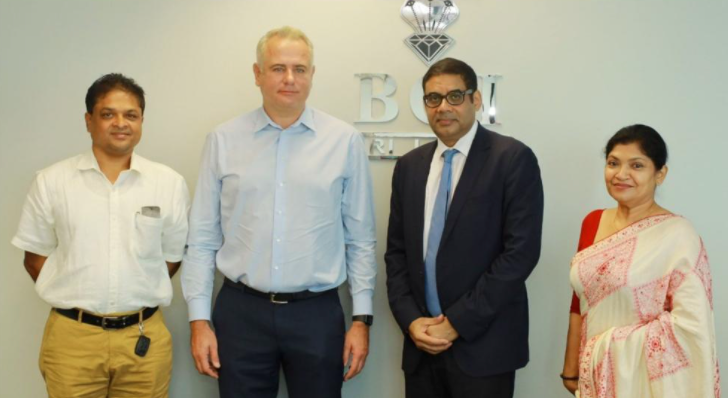
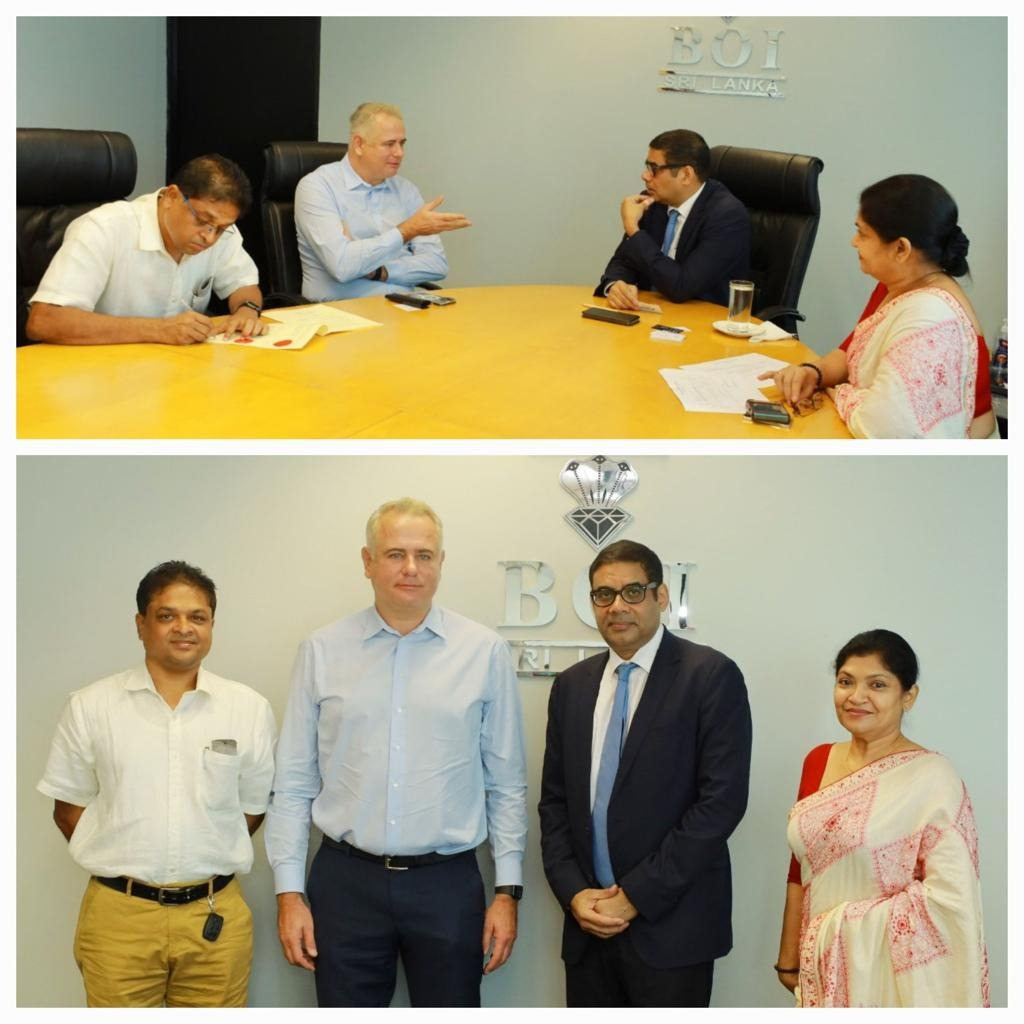
“This is quite alarming, and we are dumbfounded by this unprecedented move by the PUCSL as some of the enterprises might be facing the danger of closure,” FTZMA Chairman Jatinder Biala and Secretary Dhammika Fernando informed Minister Wijesekera.

FTZMA has analysed the proposed price hike by CEB versus what has been published and that industry sectors in all categories are currently experiencing the largest hikes. “This incremental cost is going to add to their manufacturing cost which would result in making ‘Made in Sri Lanka’ products in export markets highly uncompetitive,” FTZMA warned.

“Moreover, the Small Medium Entrepreneurs (SMEs) in the category 1-1 being hit hardest by this price hike are extremely worried about the impact on their liquidity position and business survival,” it emphasised.

Minister Wijesekera was told that the attractiveness of Sri Lanka for foreign direct investment (FDI) is evaluated by using many criteria of which the cost of operation is a significant determinant because energy cost, electricity is directly associated with the cost of production of the investors.

FTZMA has urged the Minister to revisit and analyse the price structure once again, bearing in mind that FDIs are the future lifeline and the back-bone of Sri Lanka’s economy.

It also expressed hope that the Minister would realise the overall impact on investors who are seeking a reasonable revision in the price change. A meeting with the Minister has also been sought by the FTZMA to discuss the issue further and reach a win-win agreement.

Govt allocates US$20mn from Indian credit for animal feed

0

Families with limited income have been struggling to cope up with the hike in commodity prices following the current economic crisis.

Many middle-class families have cut their menu of fish, egg, meat and vegetables to manage the expenses as the price of egg has gone up to rs 70 from Rs 50 and the price of a kilo of chicken meat risen to Rs.1700 from Rs1300 recently.

The All Ceylon Bakery Owners’ Association has urged President Ranil Wickremesinghe’s government to act fast to curb the rise in egg costs and import eggs from India at a discount.

According to N.K. Jayawardena, President of the Association, eggs are now sold in India for about 18 rupees, but it is very simple to import eggs from India and sell them for 20 rupees.

Under This set up , Sri Lanka plans to use 20 million US dollars from a billion US dollar credit line from India to import maize to make animal feed, Trade and Food Security Minister Nalin Fernando said.

“One of the biggest problems we had in recent months was the difficulty in getting raw materials for poultry farmers to make feed,” Trade and Food Security Minister Nalin Fernando said.“That is one reason the price of chicken and eggs went up so sharply.

“So Trade Ministry has allocated US$ 20 million US from the Indian credit line to import maize.”

Sri Lanka printed money for two years to suppress rates leading to a collapse of a soft-peg with the US dollar from 182 to 360 to the US dollar with the currency falling from 200 from March 2022.

Due to a failed float and continued money printing forex shortages continued.

Sri Lanka’s domestic maize production was also hit by a ban on chemical fertilizer. Though it was relaxed in late 2021, forex shortages from the broken peg made it difficult to import fertilizer.

Minister Fernando said imports of maize will be made until domestic production recovers.

Meanwhile the central bank had also raised rates to kill private credit and reduce forex outflows and inflation. The external sector as well as domestic money growth has sharply shown in May and June 2022.